Theology of Undying Waste: When Temporary Things Refuse to Die
Introduction
Humanity has developed the capacity to manufacture things that remain in the environment long after their usefulness has ended. Plastic products are broken down into very minute particles that are not easily noticeable that persist in soil and oceans, while automated digital content accumulates on servers and circulates across the internet. Whereas these two phenomena belong to different domains, they raise a common question: What happens to matter that was created for temporary use refuse to die or rot?
This question requires a theological reflection on the relationship between what God created, human responsibility, and the consequences of what s produced by this man. In our discussion, two metaphors are proposed: Fallen Manna, representing persistent plastic waste, and Digital Sheol, representing the accumulation of automated or artificially generated online content. These metaphors are interpretive images developed for this article; they are not literal biblical teachings or terms that are explicitly used in Scripture to describe modern technology.
Biblically speaking, the central concern is not that everything must decay quickly. Other natural creation of God like rocks, mountains, and other elements of creation may endure for generations. Our concern now is whether human beings exercise wisdom and responsibility in managing what they produce. This article examines that question through biblical theology, scientific evidence, and practical applications of Christian stewardship.
1. Why Returning to Dust Matters
In Scripture, many living things are made to live, die, and return to dust. This is not a rule that everything must rot quickly. God also made rocks and mountains that last for ages. The point is ethical. When something is meant to be temporary, letting it return is good care.
God told Adam, "Dust thou art, and unto dust shalt thou return" (Genesis 3:19). In its setting, this speaks about human death and our need of God, not about plastic. Yet it reminds us that we are formed from dust and are not owners of creation. In Genesis 2:15, the Hebrew word shamar means to guard and keep.
2. Manna That Was Meant to Rot
Israel was told not to keep manna until morning. Those who kept it found it bred worms and stank (Exodus 16:19-20). The rotting had a purpose. It stopped hoarding and taught daily trust.
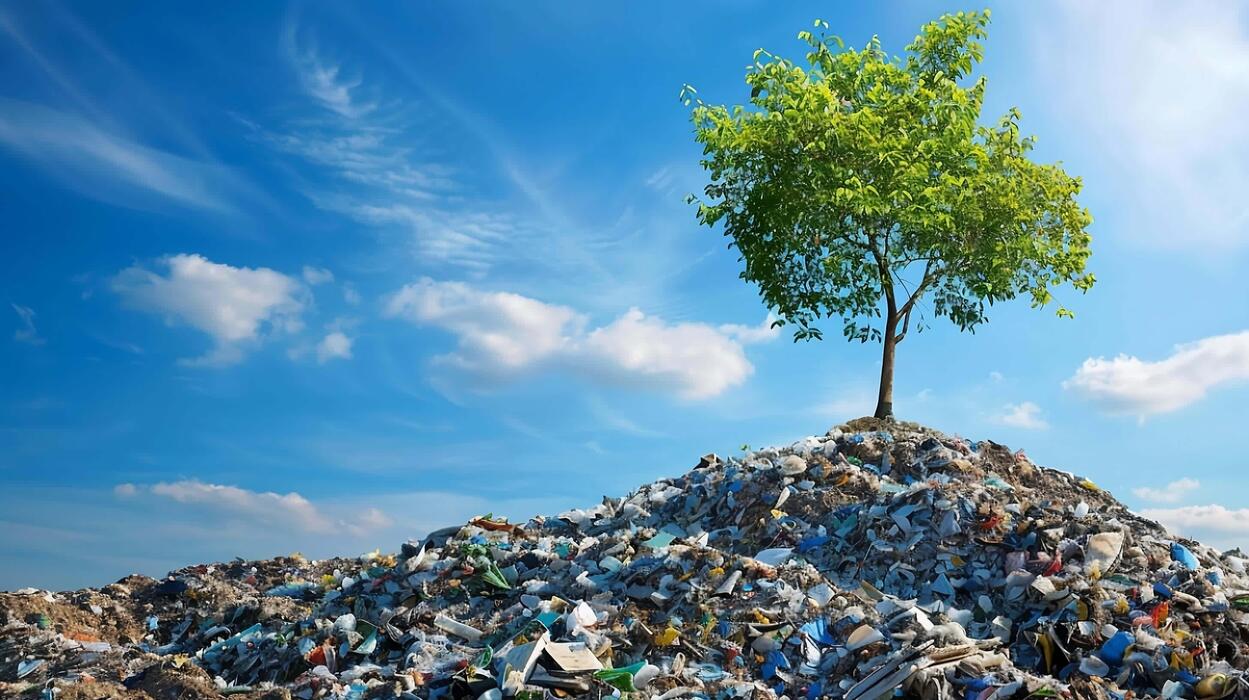
I call microplastics Fallen Manna, because they are the opposite. Unlike the manna that spoiled, plastic may fragment into smaller particles without fully disappearing. These particles can remain in terrestrial and aquatic environments, creating challenges for ecosystems and waste-management systems.
What Does the Evidence Say?
As much as plastics don’t decay and last for quite a number of years, no study proves that they last 500 years, as some claim. Scientific research claim that plastic persistence is influenced by a number of factors including its chemical composition, physical form, and environmental conditions. For one common plastic, high-density polyethylene (HDPE), in the sea, half-life ranged from 58 years for bottles to 1,200 years for pipes (Chamas et al., 2020). Even if all plastic stopped entering the ocean today, about 10% would still be at the surface after 100 years (Wu et al., 2025).
Plastic is also inside us. One study found plastic particles in the blood of 17 of 22 healthy donors (Leslie et al., 2022). Another study supporting this argument found microplastics in all 62 placentas tested (Garcia et al., 2024). however, the presence of plastic particle in the human body However, does not, by itself, establish the extent of health effects or prove that a particular exposure causes a specific disease. This only calls upon more research and further interrogations on what effect will it cause to humanity and nature as a whole.
This plastic pollution and persistence is not far off in the ocean shores and distant places, in Nyamira and Kisii, we see this along the roads, riverbanks, shambas,and even homesteads. When openly burned, they choke the air.
3. Shadows Under the Water
Job says, "Dead things are formed from under the waters" (Job 26:5). The Hebrew word is Rephaim, the weak shades of the dead in Sheol.
I call the bot-filled internet Digital Sheol. Digital Sheol addresses the accumulation of automated online activity and content that may appear human-generated even when no person is directly responsible for its production or interaction.
Imperva reported automated traffic was 49.6% in 2023 and 51% in 2024 (Imperva 2024, 2025). This includes good bots like search engines, so it is not all harmful. Still, it shows a large share of online activity is not human.
4. What the Sabbath Teaches Us
The biblical Sabbath offers a unifying perspective on environmental responsibility and digital practice. God rested on the seventh day (Genesis 2:2-3). God also commanded a Sabbath for the land (Leviticus 25:4). Creation needs rest. The Sabbath is not presented as a sign of weakness or failure but as a sacred rhythm within God's created order.
When taken as a whole, these verses challenge Christians to reevaluate cultures that require constant consumption, and digital productivity. The idea that every resource must be continuously utilized, every moment occupied with activity, and every opportunity utilized to produce more material is called into question by the Sabbath.
For plastic: Sabbath theology encourages restraint in the production and consumption of disposable materials. Cut down on single-use plastic. Choose reusable bags and bottles.
For digital life: Do not keep every file forever. Digital stewardship also requires protecting privacy, particularly that of children and vulnerable individuals. Publish less, but publish what is true and checked by a person.
For the Sabbath itself: Church workers should not receive push notifications on Sabbath. Schedule posts before Sabbath begins. Let people and systems rest.
Conclusion
Ecclesiastes 3:20 is good news. We all come from dust and return to dust. Things that can end can also be made new. What is sown in corruption is raised in incorruption (1 Corinthians 15:42). Sometimes faithful care means letting things end well.
This article uses theological metaphors for reflection and does not claim Scripture speaks directly about modern plastics or artificial intelligence.
The metaphors of Fallen Manna and Digital Sheol point toward three related responsibilities.
First, Christians should recognise that human production has consequences beyond immediate usefulness.
Second, Christians should distinguish usefulness from mere accumulation. The biblical manna narrative illustrates the danger of acting contrary to divine instruction in an attempt to preserve what was not meant to be stored in that manner.
Third, Christian stewardship should embrace accountability. Environmental responsibility requires informed choices about materials and waste. .
References
Chamas, A., Moon, H., Zheng, J., Qiu, Y., Tabassum, T., Jang, J. H., Abu-Omar, M., Scott, S. L., & Suh, S. (2020). Degradation rates of plastics in the environment. ACS Sustainable Chemistry & Engineering, 8(9), 3494–3511. https://doi.org/10.1021/acssuschemeng.9b06635
Garcia, M. A., et al. (2024). Microplastic presence in human placenta: Evidence and implications. Toxicological Sciences, 199(1).
Imperva. (2024). 2024 Bad Bot Report. Thales.
Imperva. (2025). 2025 Bad Bot Report. Thales.
Leslie, H. A., van Velzen, M. J. M., Brandsma, S. H., Vethaak, A. D., Garcia-Vallejo, J. J., & Lamoree, M. H. (2022). Discovery and quantification of plastic particle pollution in human blood. Environment International, 163, Article 107199. https://doi.org/10.1016/j.envint.2022.107199
Wu, et al. (2025). Philosophical Transactions of the Royal Society A, 383.